
🎧 Listen on Spotify!
Perfect for busy equestrians! Get your elite showjumping news at jump-off speed while you're cleaning stalls, driving to the barn, or out for a hack. Be the most informed person at your next show!
🚨 FEATURE STORY: Wings Clipped
The Crash That Changed Everything
On November 4, 2025, at 5:13 PM, UPS Airlines Flight 2976 began its takeoff roll from Louisville Muhammad Ali International Airport, bound for Honolulu with a full cargo load. The McDonnell Douglas MD-11 freighter—registration N259UP—accelerated past V1, the point of no return. Moments later, at approximately 185 knots, the Number 1 engine under the left wing tore itself free.
Security footage captured the catastrophic sequence: the pylon connecting the 60,000-pound-thrust turbofan to the wing fractured at the aft mount, allowing the engine to pivot violently upward before vaulting over the wing's leading edge. The aircraft briefly became airborne before banking sharply and impacting an industrial area less than a mile past the runway. All three crew members perished, along with eleven people on the ground.
The National Transportation Safety Board's preliminary findings were chilling: "fatigue cracks on multiple fracture surfaces of the left pylon's aft-mount lugs." Translation—microscopic cracks had been growing undetected inside critical structural components, hidden where standard visual inspections couldn't see them. The metal had simply been stressed too many times over too many years.
The Regulatory Hammer Falls
Four days later, the Federal Aviation Administration issued Emergency Airworthiness Directive 2025-23-51. Every MD-11 in the United States was grounded immediately pending invasive inspections that require removing engines, disassembling pylon components, and performing high-frequency eddy current testing to detect internal cracks. The directive later expanded to include DC-10 and MD-10 variants due to shared pylon design.
For FedEx Express, which operates 58 MD-11 freighters, the grounding couldn't have come at a worse time. Peak holiday shipping season—when every cubic foot of cargo space is worth its weight in gold—was just beginning. With its MD-11 fleet suddenly unavailable, FedEx scrambled to redeploy every Boeing 777 and 767 it could find to cover the surge in package volume.
Something had to give. On November 25, FedEx notified shipping agents that all domestic equine transport was suspended through January 2026.
Why This Matters: The MD-11 and Horse Transport
The MD-11's role in equine transport isn't easily replaced. These tri-jet widebodies have the payload capacity, range profile, and—critically—the main deck configuration needed for specialized horse stalls. FedEx has been the sole scheduled domestic carrier for equine air transport since Tex Sutton's "Air Horse One" suspended operations in 2021 due to regulatory issues with its Boeing 727.
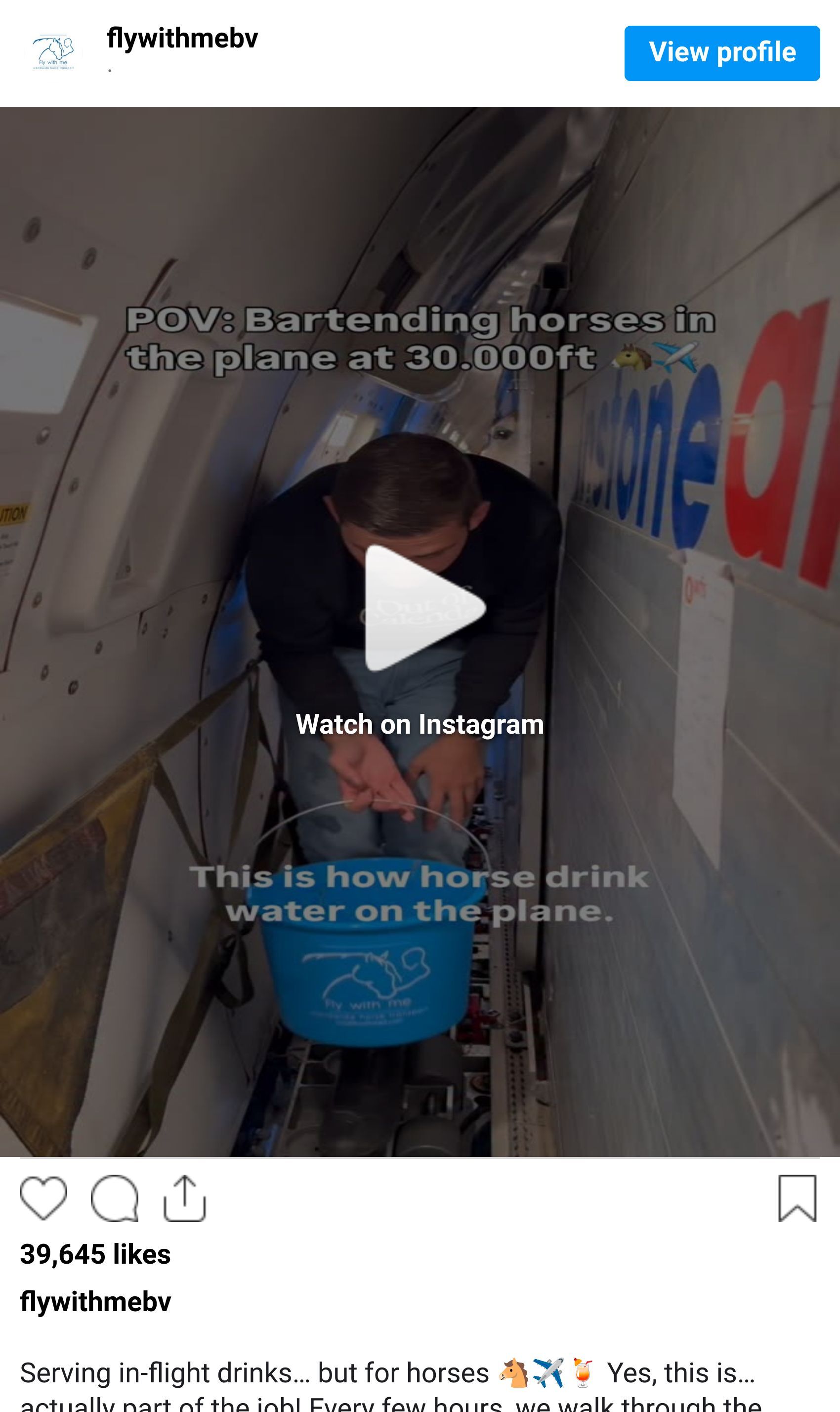
The MD-11 handles the transcontinental trunk routes that mirror the migration patterns of the sport: Newark to Los Angeles, Memphis to Oakland, East Coast to Florida. Horses travel on the main deck in modified AKE containers configured as "jet stalls," which require specific loading procedures, climate control, and space that smaller aircraft simply can't accommodate.
FedEx's newer, more fuel-efficient 777s? Reserved for high-yield international cargo to Asia and Europe. The grounded MD-11s were the domestic workhorses—literally.
The Perfect Storm
The timing compounds the crisis. FedEx typically pauses most horse flights from mid-December through early January anyway—the holiday package surge always takes priority. But the MD-11 grounding pushed that suspension forward by three weeks, right into the critical window when horses need to move to winter circuits.
The Winter Equestrian Festival in Wellington, Florida—a 12-week spectacle that generates over $500 million in economic impact for Palm Beach County—expects 15,000 horses. The Desert International Horse Park in Thermal, California hosts Major League Show Jumping's season finale with $750,000 on the line. Horses competing in these circuits typically fly.
Not this year.
The Alternatives: All Bad
With FedEx out, the industry has been forced into a brutal cost-benefit analysis:
Private Air Charter: In theory, chartering a Boeing 747-400F could move 60+ horses in one flight. In practice, it costs $150,000 to $250,000 for a domestic leg. Even with 60 horses splitting the cost, owners are looking at $10,000-$15,000 per horse—triple the normal FedEx rate of $3,500-$5,000. Finding an available 747 freighter not already committed to military or commercial contracts? Nearly impossible.
Ground Transport: The only realistic option for most. Commercial van companies like Brook Ledge and Equine Express are facing unprecedented demand they simply cannot absorb. A cross-country van ride costs $2,500-$3,500 shared, or $8,000-$12,000 for a private charter. But money isn't the biggest cost—time is.
A flight from New York to California: 6-8 hours. A van: 40-50 hours minimum. A horse that flies can be ridden the next day. A horse that spends four days in a trailer needs 7-10 days of recovery before returning to full work. That's missed training, missed competition dates, and lost ranking points.
The Veterinary Risks
The mass shift to ground transport introduces welfare concerns that go beyond inconvenience. The most significant threat is pleuropneumonia—commonly called "shipping fever."
Horses naturally clear their respiratory systems using the mucociliary escalator, which relies on gravity. They need to lower their heads to drain mucus and debris from their airways. In a trailer, horses are typically tied with heads elevated for safety. Over a 40-hour cross-country haul, this prevents proper airway clearance. Bacteria, dust, and particles colonize the lower lungs, causing severe, potentially fatal pneumonia.
Studies show transport duration is the single biggest risk factor. Journeys exceeding 12 hours see a sharp spike in shipping fever cases. A transcontinental trip is 3-4 times that threshold.
Then there's biosecurity. Flying offers point-to-point transport—a horse loads in New York and unloads in Wellington without stopping. Ground transport requires layover facilities in states like Texas or Tennessee where horses rest. These communal facilities become potential disease vectors, particularly concerning given the active EHV-1 (Equine Herpesvirus) outbreak currently affecting barrel racing events in the region.
High-performance show jumpers sharing airspace with potentially exposed rodeo stock? That's the nightmare scenario competition veterinarians are working overtime to prevent.
Who Gets Left Behind
Thoroughbred trainer Todd Pletcher's colt Noble Confessor missed the Grade 1 Hollywood Derby at Del Mar when his California flight was canceled. That's one race, potentially hundreds of thousands in lost purse money and stud value.
Graham Motion, training Herringswell Stable's string at Del Mar, faced the prospect of vanning Grade 1 horses 3,000 miles back across the country. "It's frustrating," Motion told reporters, the understatement heavy with the reality of disrupted training schedules and compromised preparation.
The immediate impact hit dozens of horses that competed at the jumping World Cup qualifier at Santa Anita last weekend—horses now seeking transport to Thermal for Major League Show Jumping competitions or trying to return to Florida. The three top-ranked Americans—Kent Farrington at World No. 1, Laura Kraut at No. 8, and McLain Ward at No. 11—all competed in California and are based in Wellington for the winter.
The Bizarre International Advantage
Here's where it gets absurd: it's currently easier to import a horse from Europe than to move one from California to Florida.
International carriers like Cargolux, Lufthansa, and Emirates operate Boeing 747-8Fs and 777Fs that aren't subject to the MD-11 grounding. Cargolux's 747-8F can carry up to 90 horses in a single flight, and these aircraft continue arriving in Miami and New York on schedule. European sales barns suddenly have a logistical advantage over American sellers on the West Coast. You can buy a warmblood in Belgium and have it in Wellington faster than you can move your own horse from Los Angeles.
The Long View
The MD-11 entered service in the 1990s. Production ended in 2001. The youngest airframes are nearly 25 years old; many are over 30. While aircraft can fly indefinitely with proper maintenance, metal fatigue becomes statistically more probable as stress cycles accumulate. The Louisville crash exposed what may be a systemic vulnerability in the entire fleet.
Even after inspections are complete and the FAA lifts restrictions—optimistically projected for late January 2026—the MD-11's long-term viability for equine transport is questionable. Boeing hasn't built these aircraft in over two decades. Replacement parts aren't in production. The fleet is aging out.
The American equestrian industry just learned it was one engine separation away from logistical paralysis. When the MD-11s do return, the sport needs to start asking hard questions about redundancy, alternative carriers, and whether a multi-billion dollar industry should depend entirely on the auxiliary capacity of a single logistics provider operating aircraft old enough to have their own frequent flyer miles.
For now, thousands of horses are learning that sometimes the biggest obstacle in show jumping isn't a 1.60m vertical—it's getting to the arena in the first place.
Quick Hits: The Week's Competitions
🇸🇪 CSI4* Sweden International Horse Show - Stockholm
The Belgian Invasion of Strawberry Arena
The Swedes threw a party at their signature indoor event. The Belgians crashed it and took home the trophies.
Gilles Thomas, riding Chuck Marienshof Z (Colestus x Emerald van 't Ruytershof), won the €26,902 H&M Grand Prix in commanding fashion. The young Belgian's jump-off time of 34.22 seconds held off Brazil's Marlon Módolo Zanotelli on Charly Heart (34.96s) and Olivier Philippaerts—yes, another Belgian—on H&M Miro (35.13s). The Belgian contingent effectively shut the Swedish home heroes off the podium, a rare and stinging result in Stockholm.
H&M Grand Prix Podium: View full results
Gilles Thomas (BEL) - Chuck Marienshof Z - 0/0 in 34.22s - €26,902
Marlon Módolo Zanotelli (BRA) - Charly Heart - 0/0 in 34.96s - €21,522
Olivier Philippaerts (BEL) - H&M Miro - 0/0 in 35.13s - €16,141

In Saturday's speed class, France's Kevin Staut delivered a masterclass aboard Kannonqulan (Kannan x Quantum), winning by over two full seconds—an eternity in jump-off terms. Henrik von Eckermann salvaged some home pride with second place on Glamour Girl, giving the crowd something to cheer about beyond Peder Fredricson's opening-day victory.
🇺🇸 CSI4* Holiday & Horses - Wellington, Florida
Kent Farrington's Unstoppable 2025 Continues
Riding Greya (Colestus x Contender), Farrington won the $200,000 Holiday & Horses Grand Prix. His jump-off time finished approximately six seconds ahead of second place. Six seconds. In competitive jump-offs where margins are measured in hundredths, that's a statement performance that borders on intimidation.
$200,000 Grand Prix Podium: View full results
Kent Farrington (USA) - Greya - 0/0 (~6 sec margin of victory)
Hallie Grimes (USA) - Karoline of Ballmore - 0/0
Shane Sweetnam (IRL) - Coriaan van Klapscheut Z - 0/0

This victory marks Farrington's 15th Grand Prix win of 2025—with one month still to go in the year. That's averaging more than a GP win per month, with eight of those titles coming at the 5* level. To put that achievement in context, his closest competition is two-time Olympic gold medalist Scott Brash with eight GP wins total this year.
Greya is the hero of Farrington's string. With seven GP wins this season, she's eclipsed former Farrington mount Gazelle's record of six GP titles in a single season (set in 2017). At just 11 years old, Greya already has 10 career GP wins and is closing in on the all-time record of 17 GP victories set by both Gazelle and McLain Ward's HH Azur.
With four weeks left in 2025 and his win streak still raging, Farrington is only competing against himself for records.
France's Nina Mallevaey showed she's ready for the senior circuit by winning the $117,000 qualifier aboard My Clementine, edging out Canada's Chris Pratt by just over half a second. Canadian Erynn Ballard also picked up silverware in the 1.50m Classic aboard New Star vd Berghoeve, demonstrating the depth and versatility that makes her one of North America's most consistent performers.
🇸🇦 CSI3* Riyadh - Saudi Arabia
German Speed Meets Saudi Ambition
David Will brought Teutonic efficiency to the desert, winning the CSI3* Grand Prix aboard Xixo Borgia (Big Star x Sandro Boy) in 35.05 seconds. But the real story was what happened behind him.
Saudi Arabia's Ramzy Al Duhami—Olympic veteran and multiple-time championship competitor—pushed Will to the limit, finishing just 0.67 seconds back on Addressee (Messenger x Chacco-Blue). Fellow Saudi rider Khaled Almobty rounded out the podium in third. Two Saudi riders forcing a world-class German speed specialist to execute at his absolute peak? That's the narrative Saudi Arabia's Vision 2030 equestrian investment was designed to create.
CSI3 Grand Prix Podium: View full results
David Will (GER) - Xixo Borgia - 35.05s
Ramzy Al Duhami (KSA) - Addressee - 35.72s
Khaled Almobty (KSA) - Qaparezzo-A - 36.35s

The presence of top-level European breeding in Saudi stables—Chacco-Blue bloodlines, Big Star offspring—combined with increasingly sophisticated horsemanship signals that the Middle East circuit isn't just about prize money anymore. It's becoming genuinely competitive.
🚨 Industry News
EHV-1 Biosecurity Alert
The United States Equestrian Federation issued an urgent biosecurity alert on December 1 following confirmed cases of Equine Herpesvirus Myeloencephalopathy (EHM)—the neurological manifestation of EHV-1. The Barrel Futurities of America suspended an Oklahoma event after a positive test.
The timing is critical. Thousands of horses are currently migrating to winter circuits, and the convergence of horses from different geographic regions creates ideal conditions for viral transmission. The active outbreak is primarily affecting barrel racing events in Texas and Oklahoma—states that serve as layover points for horses vanning cross-country. With FedEx equine flights suspended, more horses are traveling by ground through these exact regions, significantly increasing biosecurity risks.
USEF has mandated strict temperature monitoring protocols and isolation procedures for new arrivals at competition venues. Wellington International and other major facilities have implemented enhanced declaration requirements. A widespread outbreak during the winter season could force competition suspensions similar to the devastating Valencia EHV-1 outbreak that disrupted European competition in 2021.
Looking Ahead: December 2-8, 2025
The first full week of December brings World Cup points in Europe and massive prize money in California—assuming horses can actually get there.
⭐️⭐️⭐️⭐️⭐️ CSI5-W A Coruña (Casas Novas) - Spain 🇪🇸
The Longines FEI World Cup Western European League continues at one of the world's most luxurious indoor venues. The €320,000 Grand Prix on Sunday (1.60m) is a critical qualifier for riders chasing World Cup Final spots. The compact arena rewards technical horses that are quick off the ground—expect the indoor specialists to dominate.
⭐️⭐️⭐️⭐️⭐️ CSI5/CSI2 Desert Holiday I - Thermal, California 🇺🇸
The Major League Show Jumping season finale features the $750,000 Coachella Cup Grand Prix on Saturday, December 6. With 150 FEI ranking points on the line, this is a magnet for riders chasing world ranking status. The $200,000 MLSJ Team Competition on Sunday adds unique competitive dynamics. Whether the full caliber of expected talent actually makes it to Thermal remains to be seen.
⭐️⭐️⭐️⭐️ CSI4-W Poznan (Cavaliada Tour) - Poland 🇵🇱
Part of the Central European League World Cup, Poznan's Cavaliada Tour is famous for its raucous atmosphere. Friday's "Speed & Music" class (1.40m) is pure entertainment—riders blasting around a course to high-tempo music. Sunday's 1.55m World Cup Grand Prix is critical for Central and Eastern European riders aiming for the World Cup Final.
⭐️⭐️⭐️⭐️ CSI4 Salzburg Arena Messezentrum - Austria 🇦🇹
Austria's indoor season heats up with four days of competition at the Messezentrum. Strong Central European contingent expected.
⭐️⭐️⭐️ CSI3 Ocala - Florida, USA 🇺🇸
⭐️⭐️⭐️ CSI3 Oliva - Spain 🇪🇸
⭐️⭐️⭐️ CSI3 Queretaro - El Marques, Mexico 🇲🇽
This Week's Rating: 7.2/10
This week gets a 7.2 for solid international competition despite the absence of 5* events. The CSI4* level delivered quality sport across three continents—Gilles Thomas's dominant performance in Stockholm, Kent Farrington's intimidating statement in Wellington, and the continued rise of Saudi Arabian equestrianism in Riyadh all provided compelling storylines. The entertainment value was there, particularly in Farrington's six-second margin of victory, which felt like watching someone play a different sport than everyone else.
However, the week's rating is tempered by the stark reality of the MD-11 crisis, which has created a logistical paralysis that threatens the entire winter season structure. Field quality at upcoming events will suffer as horses simply cannot reach competition venues, and the biosecurity concerns introduced by forced ground transport add genuine danger to an already difficult situation. The industry is learning an expensive lesson about infrastructure fragility—sometimes the biggest obstacle in show jumping isn't the course, it's getting to the venue.
Know a showjumping fan who's always rushing to catch up on the sport's biggest moments? Share this newsletter with them! Every week, JumpOff.news delivers the most important elite showjumping news in a concise, easy-to-digest format—so they'll never miss another historic hat-trick or breakthrough performance.
Stay tuned to JumpOff.news for all the latest coverage... make sure to subscribe, share with fellow equestrians, and follow all the action as it unfolds, here at JumpOff.news, elite showjumping news, jump-off speed!